Akamba Traditional Marriage
1. Starting a friendship
When a boy and a girl come to a secret agreement that they love each other and want to marry, the young man's father, if he agrees, approaches the girl's parents on the matter. This is followed by the first sign of sealing an in-law relationship (uthoni) with two goats (mbui sya ntheo). The young suitor then prepares the best beer (uki) which is taken to the girl's father, followed by a negotiation on the bride-wealth. The negotiation is done between the two extended families, but the family of the girl has the last say. Once an agreement has been reached by the elders of the two families, the dowry may spread for years because marriage is a life-long relationship.
2. Bride-wealth and Taking the Bride Home
When the amount of the bride-wealth is finally set and agreed upon, sometimes depending on customs from one place of Ukambani to another, the young man would come any time and quietly take the bride away to his home. On the following day, the boy brings gifts to the girl's mother, usually bananas, in order to sooth her feeling for having lost a daughter, and provides plenty of beer for the bride's father to enjoy with his family elders.
In the event that there is no secret capture of the bride, the suitor brings a bullock which is killed and divided into two halves. The mother is given one half and the other is given the groom's friends who accompany him to the in-laws. Girls were married between 12 to 18 years of age, while boys married later, at about 20 to 25. Soon after the above festival the bride is fetched by the groom accompanied by his friends and quietly taken home usually in the evening.
On arrival at the groom's home, the bride stops at the door of the home (threshold), and there she is ritually anointed on the neck by the groom's mother. After that she is welcomed into the house. That night the bride and bridegroom sleep together for the first time, but traditionally that are forbidden to have intercourse. Early in the morning the following day at the second crow of the cock (about 5 a.m.), the new bride wakes up and symbolically sweeps the house then goes back to bed. This is to indicate her role in the family and willingness to help her in-laws in the daily chores. That day in the evening, the girls of the bride's age group and friends arrive to comfort her by a ritual of singing and wailing (literally called 'maio'=wailing), which lasts two days. The girls usually bring some gifts of food or items that their friend could use in her new home. After this ritual the bride is considered a married woman. Thus life returns to normal and the appearance of pregnancy is eagerly awaited, proving that the match is a fertile one. Even though the couple is married, the husband is expected to send gifts to his in-laws from time to time.
Forced marriage was almost unknown among the Akamba. There is always generally mutual affection between the two marital partners. However, there were exceptions when out of greed the father of gave away his daughter to a rich man for whom the girl had no affection. In cases like this, the man runs the risk of losing her. There were cases when girls in this situation simply took away their life as a solution. Lindblom affirms this when he says that "more than one girl in such a position has taken her own life, and has been found hanging by a strap round her neck to the roof of the hut, or to a tree in the fields" (cf. Lindblom, p. 77).
3. Divorce
The Akamba practiced divorce on specific accepted reasons. The grounds on which a husband could divorce his wife included idleness, laziness, disobedience and habitual unfaithfulness. The husband too could get a divorce if the wife was discovered to be a witch. The wife could demand a divorce on the basis of merciless and recurrent beatings by her husband. If the wife was sick and the husband refused to get her the necessary medicine or if she could not conceive, and her husband refused to take her to the medicine-man/woman for the necessary diagnosis and treatment, she could also seek for divorce.
Among the Akamba it was and still is the wife's duty to provide food for the family from the family cultivated land. The wife could ask for divorce if the plot of land was too small and the husband refused to negotiate a larger piece of land (cf. Penwill, pp. 15-18). The husband traditionally made sure that the wife had little to complain about. In other words he tried his best to fulfill all her needs including food security even during the famine period for which he was not to blame at any rate. By custom, an Akamba man must not strike his wife if he did so he was require to one goat for sacrifice by the elders. Of course the greater part of the meat was eaten by those present. Indeed the Akamba married woman was more or less the master of the family in the long run, since the husband had little control over her in the day to day management. If such a freedom to manage the home was absent, the husband had the danger of his wife becoming exasperated and running away. The husband had to avoid such situations of a wife running away back to her parents, because of fear he might not recover the dowry he gave to her parents, which could only happen if his former wife re-married. In the case of re-marriage, the new husband was obliged to refund all the dowry paid to the former husband. In the final analysis what this system did was to reduce exceedingly the number of divorce cases.
4. Sterility in Marriage
The Akamba value children in marriage. Thus if a man proved impotent, he was supposed to invite a trusted friend to perform the coitus necessary for pregnancy. Akamba traditional society accepted this custom as proper. The biological father in this case had nothing to do with the child since the real husband was considered the true father (cf. Lindblom, p 83). Yet the Akamba always remained cynical and reticent about this custom as evidenced in some of their lyrics concerning a woman or a man involved in such relationship, particularly if the offspring happened to be a deformed or highly gifted child. The lyrics were either in mockery or in praise of the man of the woman. The lyrics were never to be sung any how but at joyful events such as at the harvest festivals.
If an Akamba girl does not become pregnant soon after marriage there was great concern. She was taken to see a diviner (mundu mue) who was an expert in such matters. The Mundu Mue who was either a man or woman mixed latex from a fig tree, the undigested mixture from a goat's stomach, and a little of the woman's menstrual blood. This mixture was smeared on the woman's navel (cf. Lindblom, p. 84).
It was considered highly important for every Akamba man to be married because it was his wife and children that would guarantee keeping his memory beyond his death. If an Akamba man died before marriage, the father arranged to obtain a wife for the dead son. Such a girl was married to the name of the "unmarried man who has died. She bears him children, usually by his brother as genitors" (cf. Middleton, p. 90). Little wonder then, that polygamy gradually sneaked into Akamba custom out of such practices, and thank God no longer exist. But polygamy developed to be an institution linked to the economy, since one man with many cattle and large pieces of land needed more and more wives and children to manage that property. Other factors of polygamy were the sterility of the first wife, who was always consulted before the husband took another wife. Since polygamy was always linked to the economic needs, the custom is no longer considered as viable model of marriage among the Akamba of today.
5. References Cited
Dundas, C. "History of Kitui", in Journal of Royal Anthropological Institute, 43:480-549, 1913.
Lindblom, G., The Akamba in British East Africa,2nd Edition, Negro University Press, NY, 1969.
Middleton, J. The Central Tribes of the North-Eastern Bantu, London: International African Institute, 1953.
Penwill, D.J., Kamba Customary Law, London: Macmillan and Company, 1951.
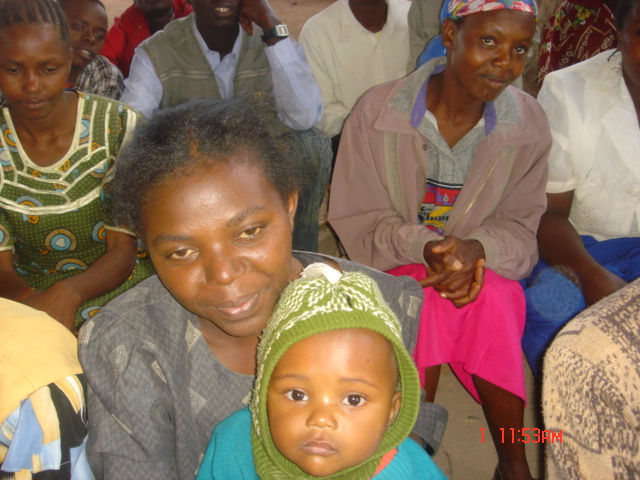 John Mbinda, my cousin requested me to carry out a research and write on the Akamba women living in Kwale District, Coast Province in Kenya. The research was to be on modern Akamba women - their hopes and aspirations, and even their problems. My research took two weeks during which I talked to quite a good number of Akamba women either residing permanently or working in Kwale. Most of the women have been living here for 40 years (having migrated from Ukambani with their parents when they were children). Others have made Kwale their permanent homes after they got married to men who have been raised here, while a small number stay in the district because they work in government offices or schools.